Click here to see this email on your browser.
Böll EU Newsletter 11/2025
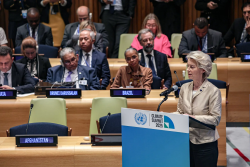
In an unruly world, can Europe still set rules?

Dear Friends,

For years, the EU was known as the quiet superpower of global regulation. It didn’t dominate through troops or tariffs, but through standards. From chemicals and data protection to climate rules, the so-called “Brussels Effect” meant that when the EU regulated, the world often followed. 

Now, across multiple fronts, the EU’s rules are being challenged. The United States and Qatar have called on Brussels to roll back its due diligence rules. Countries in the Global South are pushing back against the EU’s anti-deforestation law and carbon border mechanism. While tech bros insist the EU water down its digital rulebook. Instead of Europe shaping the world, the world is increasingly shaping Europe. Or, as Gideon Rachman recently put it: “The scramble for Europe is just beginning".

The core of the issue is that the EU is a rules-based power in an increasingly unruly, power-based world. Europe’s instinctive response to power politics is often moral outrage and indignation - how dare they! We have seen this again in recent trade and tech skirmishes, when EU officials accused Washington of “blackmail” after US Commerce Secretary Howard Lutnick suggested that the United States might ease steel tariffs if the EU softened parts of its digital rulebook.

Outrage may feel righteous, but it is rarely a strategy towards a positive outcome. In power politics, indignation often signals vulnerability rather than strength.

Europe, however, is not weak. Biggest market in the world. Second most important global currency in the world (more on that below!). Producer of critical materials and machines. Without lithography from ASML, you can have all the rare earths in the world and won’t produce a single chip.

The global data-centre boom, including in the United States, runs largely on European power engineering. European companies build the infrastructure that the American cloud runs on. Schneider Electric, Siemens, ABB, Legrand, and others dominate markets for grid connection, transformers, switchgear, UPS systems, cooling and thermal management; all necessary for the physical infrastructure of data centres.

Yet what Europe often lacks is not capability, but the willingness to think and act in terms of power.

This hesitation shows up not only in trade and industrial policy, but also in security. For years, Europe has been the target of Russian hybrid attacks: assassinations in public spaces, railway sabotage, disinformation campaigns, GPS jamming, drones shutting down airports. The response? Mostly condemnation and resilience talk. Now, finally, a new debate is emerging about whether Europe should also develop credible offensive cyber and hybrid capabilities. This is a mindset shift that is long overdue.

Europe has great cards. It just too often refuses to play them. You don’t win at the poker table if you constantly fold.

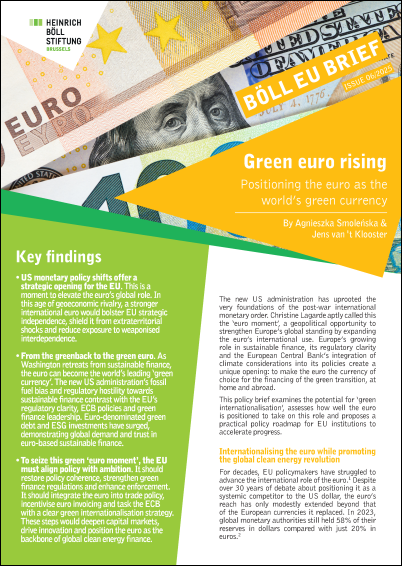
In that vein, I invite you to read our latest Böll EU Brief “Green Euro Rising”, which outlines how the euro can become the world’s green currency. We have also just published a new dossier on the EU’s long-term budget (MFF), offering in-depth analyses on the climate and social dimension. 

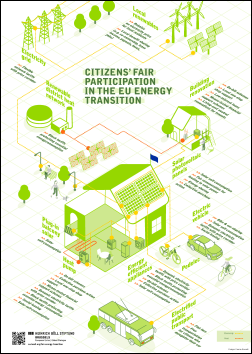
One of our core projects, carried out in cooperation with the Green European Foundation, has focused on empowering citizens to actively shape, and benefit from, the energy transition. We are proud to have just released a set of new policy briefs on strengthening citizen participation in the energy transition, together with a dedicated infographic

Warm regards,

Roderick Kefferpütz
Director
Heinrich-Böll-Stiftung
European Union | Global Dialogue

Highlights

Böll EU Brief 06/2025 | Green euro rising: Positioning the euro as the world’s green currency

The upheaval in US monetary and climate policy has opened a strategic window for Europe. With its leadership in sustainable finance, regulatory clarity and the European Central Bank’s integration of climate considerations, the EU is well placed to position the euro as the world’s leading green currency. Global demand for euro-denominated green debt and environmental, social and governance (ESG) investments is already rising. A new Böll EU Brief by Agnieszka Smoleńska & Jens van ‘t Klooster examines how ‘green internationalisation’ could strengthen Europe’s strategic autonomy, reduce vulnerability to external shocks and anchor global clean-energy finance. It sets out a practical roadmap for EU policy-makers to align ambition with action and seize this ‘euro moment’.


An MFF fit for purpose Assessing Europe’s long-term budget

With the Multi-Annual Financial Framework (MFF), the European Union defines its long-term budget – and with it, its political priorities for the years to come. In July 2025, the European Commission published its proposal for the MFF 2028-2034, and long and protracted negotiations will follow. Policy makers now have the opportunity to scale up ambi­tion and deliver on climate, social, economic and security objectives. With this web dossier, we want to give an overview over the different topics EU policy makers will need to address, and give space for commentary and analysis on the MFF.


A message to citizens: the energy transition is on your side. Let’s benefit from it!

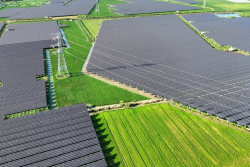
Europe’s energy transition has achieved a lot. The high share of domestic renewables in our energy mix buffered the fossil gas price crisis. During the last decade, solar power became the cheapest source of electricity, accessible at basically all citizens’ homes. So, if your bill goes through the roof, just put solar panels on the rooftop? Yes, but if things were so easy, the Green European Foundation (GEF) and the Heinrich-Böll-Stiftung would not have worked with a knowledge community of 30 energy geeks and social policy nerds during the past year on how to let citizens benefit better from the energy transition. Commentary by Jörg Mühlenhoff.

Check out the new factsheet "Can heat pumps be accessible for all? Assessing the potential of social leasing and on-bill schemes" by Marine Cornelis.

Read more
 

Clickable infographic: Citizens' fair participation in the EU energy transition

For citizens, the energy transition brings many opportunities to cut their bills. They can benefit from cheap renewables, for instance by using solar power from their rooftop. They can reduce their energy consumption, for instance through energy efficient appliances or building renovation. They can also use renewable electricity to move from one place to another. But not every household can afford the new technologies such as solar photovoltaic panels, electric vehicles or heat pumps. The EU offers several rights and regulations that facilitate citizens’ fair participation in the energy transition. Explore our infographic to see which tools make it easier to benefit from the different technologies. This will empower households to escape from rising fossil fuel prices. 

Read more
 

Web dossier: Towards a European Energy Infrastructure Union

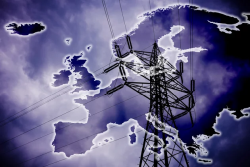
Our energy networks materialise the EU’s power of cross-border cooperation. Thanks to a well-connected grid, affordable electricity flows across the continent to households and businesses. And despite the Iberian blackout of 28 April 2025, outages remain extremely seldom and limited in time in within the EU. With the rise of a renewable, more decentralised energy system, Europe’s energy infrastructure also needs to adapt. The EU Action Plan for Grids and the EU Grids Package try to tackle the huge technical, administrative and financial bottlenecks that risk delaying the growth of wind and solar power. How can policymakers and industry advance the update of our grids? Could this task become the laboratory for a deeper integration of energy policies, evolving into a truly European Energy Infrastructure Union?

Read the new factsheet "Updating Europe’s energy networks: Lessons from the UK experience of independent system operation" by Simon Skillings.

Read more
 

Web dossier: EU-China relations: Bound by clean tech or divided by it?

Green Tech has emerged as one of the defining factors in the relationship between the EU and China, intertwining their economic ambitions and security considerations with their climate commitments. China’s massive industrial capacity, underpinned by state subsidies and export-driven scale, has given it an unrivaled grip on critical technologies and raw materials. For the EU, this asymmetry has turned clean tech from a shared ambition into a strategic challenge. Europe’s efforts to build its own clean-industrial base reflect not only environmental goals but an urgent quest for technological sovereignty. For policymakers, the question is now how to balance engagement with protection in a domain that increasingly defines both climate and competitiveness. The Beijing Representative Office of the Heinrich-Böll-Stiftung has invited four analysts from China and Europe to examine the issue from two complementary perspectives: economic security and climate diplomacy. The articles reflect the opinions of their respective authors and should be read in the context of this series.


Böll·Europe Podcast - 2025 parliamentary election in the Netherlands 🇳🇱

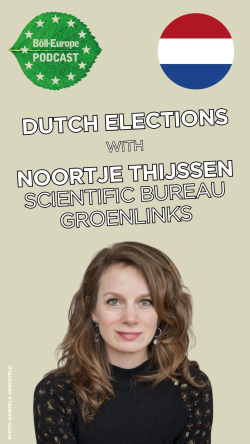
On 29 October, the Netherlands went to the polls in a much-anticipated election that could reshape the country’s political landscape – and its role in Europe. After two years of a populist government, the centrist liberal party D66, led by Rob Jetten, emerged as the winner. Meanwhile, the GroenLinks–PvdA alliance fell short of expectations, raising new questions about the future of the Dutch centre-left – and about what comes next in coalition talks. So – what happened, what’s next, and why should Brussels care? In this new Böll·Europe Podcast episode, host Joan Lanfranco talks with Noortje Thijssen, Director of the Wetenschappelijk Bureau GroenLinks, the political foundation of GroenLinks, the Dutch green party. Noortje is also since 2023 Senator for GroenLinks-PvdA at the Dutch Upper House. We unpack with Noortje the election results, the prospects for coalition-building, and what this means for the Netherlands’ direction – both at home and in Europe.


Water Atlas 2025: Data and facts about the basis of life

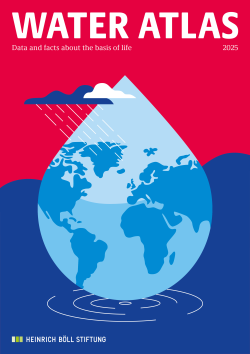
The English edition of the Water Atlas, published by Heinrich-Böll-Stiftung, presents the complexity and urgency of global water issues in a visually compelling, accessible format. It provides facts, trends, case studies, and political context to inform public discourse and shape policy. From the unequal distribution of water and industrial pollution to climate-linked water insecurity and geopolitical tensions, the Atlas aims to sharpen understanding and support action toward more sustainable and equitable water governance.

AI wants our water: While much of the AI debate focuses on its economic potential, its expanding physical footprint tells a different story. The machines driving this revolution depend on a resource far older – and far more contested – than data or electricity. Commentary by Friederike Rohde & Paz Peña for Project Syndicate.


From Brussels to Belém: Can the EU demand ambition while retreating at home?

At COP30, Europe’s climate leadership is at risk. Recent steps back on the European Green Deal and new offset rules make it harder for the EU to convince others to be more ambitious. Analysis by Seden Anlar and Claire Stam.


Energy Transition Blog

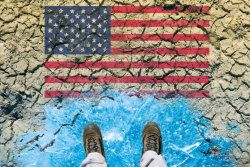
The Trump administration’s all-out war on climate protection

The Trump government has taken a battleaxe to US climate programmes and yanked the country out of international climate diplomacy. By dismantling agencies and budgets, it undermines the US’s capacity to anticipate, mitigate and adapt to the climate crisis. There is no way to put a positive spin on it. A future Democratic administration will need consecutive terms in office to reverse the carnage. Paul Hockenos reports.


Jobs

Vacancy: Administration Support (Part-time), Heinrich-Böll-Stiftung's Global Unit For Democracy and Human Rights, Brussels

The Heinrich-Böll-Stiftung's Global Unit For Democracy and Human Rights in Brussels is welcoming applications for Administration Support (Part-time). The deadline for applications is Monday 1 December 2025, 23:59 CET.

 
Photo credits:
Viktollio| Shutterstock, All rights reserved
Heimann + Schwantes, All rights reserved
Alessio de Carolis | GEF licence, All rights reserved
Emma Kersalé, Jörg Mühlenhoff & Joan Lanfranco, All rights reserved
Mino Surkala | Shutterstock, All rights reserved
Gabriela Hengeveld, All rights reserved
Eimermacher/stockmarpluswalter, CC BY 4.0
 IMAGO / ZUMA Press Wire, All rights reserved
 DarwelShots | Shutterstock, All rights reserved
Joan Lanfranco | Heinrich-Böll-Stiftung, All rights reserved
CEPS, All rights reserved

The Heinrich-Böll-Stiftung is a German political foundation affiliated with the German Green Party (Alliance 90/The Greens). Its primary task is political education and advocacy in Germany and abroad. Our main tenets are ecology and sustainability, democracy and human rights, non-violence and justice. In our work, we place particular emphasis on gender democracy, equal rights for minorities and the political and social participation of migrants.

Our namesake, the writer and Nobel Prize laureate Heinrich Böll, personifies the fundamental principles we stand for: defence of freedom and human dignity, civic courage, open debate and the acknowledgement of art and culture as independent spheres of thought and action. As a think tank for green visions and ideas, we are part of an international network with 34 offices worldwide and with partner projects in more than 60 countries.

The Heinrich-Böll-Stiftung European Union represents the foundation vis-à-vis European and international institutions, associations, non-governmental organisations and media based in Brussels. The office is a main point of contact for individuals, groups and organisations from around the world interested in EU politics and policies. The future of the European project and the role of the European Union in the world are at the centre of our activities and efforts.

If you don't want to receive any more messages (to: unknown@noemail.com), you can unsubscribe here at any time.
Heinrich-Böll-Stiftung European Union | Global Dialogue
Rue du Luxembourg, 47-51
B-1050 Brussels
Belgium

Joan.Lanfranco@eu.boell.org
Website

Your personal data is confidential and will not be forwarded to Third parties according to our Privacy Policy.