Click here to see this email on your browser.
Böll EU Newsletter 12/2025
A short note before the holidays

Dear Friends,

As the year draws to a close and Brussels gradually slows down, I wanted to take a moment to say thank you.

2025 has been intense; politically, geopolitically, and for many of us also personally. That makes the work we do together, the conversations we have, and the community around them all the more valuable. I’m grateful for your interest, your engagement, and the trust you place in our work.

Instead of a longer political reflection this month, let me keep this brief and allow the holiday period to be just that: a pause. We’ll return in the new year with renewed energy and a clear focus on the debates that will shape the months ahead.

Until then, I wish you quiet days, good conversations, and a hopeful start into the new year.

Warm regards,

Roderick Kefferpütz
Director
Heinrich-Böll-Stiftung
European Union | Global Dialogue

Highlights

Historic highs, local lows: the European Green Party in 2025

2025 brought mixed fortunes for the European Green Party: record election results in Norway and Portugal, historic membership surges in Germany and the UK, and the election of the first Green mayor in Copenhagen and Riga. However, the loss of governmental power in Germany was a notable setback. Tobias Gerhard Schminke from Europe Elects has the data and details.


Report | Source code: A trade-related barrier to the right to repair

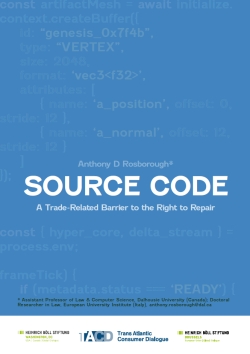
A new report commissioned by the Transatlantic Consumer Dialogue (TACD), and supported by the Heinrich-Böll-Stiftung's EU | Global Dialogue and Washington, DC USA | Canada | Global Dialogue offices, highlights mounting concerns that international trade agreements are creating barriers to consumers’ right to repair the products they own. As everyday devices from smartphones to tractors become ever more reliant on software, restrictive clauses in free trade agreements are making it harder for consumers and independent repairers to access the tools and information they need for effective repairs.


Interview | The G20 and AU-EU relations amidst global fragmentation

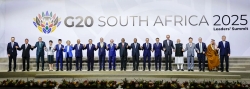
Did Africa’s first G20 presidency deliver on its promise of solidarity, equality and sustainability? Our Head of Programme for EU and International Politics, Dr. Katharina Emschermann, spoke with Paula Assubuji, Director of the Heinrich-Böll-Stiftung's office in Cape Town, about what the Johannesburg G20 and the AU-EU summit in Luanda reveal about power, inequality and the state of multilateral cooperation.


From regulation to resilience: The role of digital rules in defending democracy and security

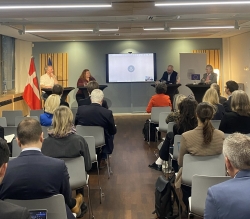
How can Europe reclaim digital sovereignty to defend democracy against hybrid threats from authoritarian states and unregulated AI-driven platforms? To answer this question we supported an event organized by Defend Democracy at the Danish Permanent Representation to the EU on 4 December.

Read more
 

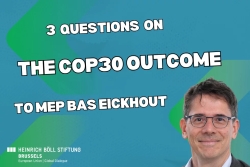
3 Questions on the COP30 outcome to MEP Bas Eickhout

The COP30 in Belém unfolded against rising geopolitical tensions, intensifying climate impacts, and deepening divides between high-ambition countries and major fossil-fuel producers. In light of the absence of the US administration and the final outcome that is weakened on key issues such as the fossil fuel phase-out, we asked MEP Bas Eickhout, Co-Chair of the Greens/EFA in the European Parliament and member of the EP delegation to the COP30 UN Climate Summit, how he assesses the Belém Package and what role he sees for the European Union in future climate diplomacy.


Commentary | An EU roadmap to phase out fossil fuels

This year's climate summit in Belem did not deliver necessary progress to limit temperature rise to 1.5°C. Similarly, the EU's contribution to the needed global emissions reductions by 2035 are not at the level required. The EU can make up for these failures by starting with the development of an EU roadmap to phase out fossil fuels, in line with its (failed) demand to get a global roadmap in the Belem conclusions.


Energy Transition Blog

Time for independent energy system operation in the EU?

The need for independent energy system operation is a live debate across the EU. It may be raised as an issue by the European Commission in their forthcoming Grids Package or White Paper on Electricity Market Design. Decisions about institutional reform are never taken lightly. They consume resource and political energy and may temporarily delay many important processes, especially if the affected parties are resistant to the proposed change. However, the cost of failing to effectively deliver policy goals is huge. We cannot wait to fail before acting.

 
Photo credits:
Marie Maerz | Shutterstock, All rights reserved
Ricardo Stuckert | CC-BY-SA 4.0, All rights reserved
Aleyna Naz Coşkun | Heinrich-Böll-Stiftung, All rights reserved
Joan Lanfranco | Heinrich-Böll-Stiftung, All rights reserved
DOERS | Shutterstock, All rights reserved
vectorfusionart | Shutterstock, All rights reserved

The Heinrich-Böll-Stiftung is a German political foundation affiliated with the German Green Party (Alliance 90/The Greens). Its primary task is political education and advocacy in Germany and abroad. Our main tenets are ecology and sustainability, democracy and human rights, non-violence and justice. In our work, we place particular emphasis on gender democracy, equal rights for minorities and the political and social participation of migrants.

Our namesake, the writer and Nobel Prize laureate Heinrich Böll, personifies the fundamental principles we stand for: defence of freedom and human dignity, civic courage, open debate and the acknowledgement of art and culture as independent spheres of thought and action. As a think tank for green visions and ideas, we are part of an international network with 34 offices worldwide and with partner projects in more than 60 countries.

The Heinrich-Böll-Stiftung European Union represents the foundation vis-à-vis European and international institutions, associations, non-governmental organisations and media based in Brussels. The office is a main point of contact for individuals, groups and organisations from around the world interested in EU politics and policies. The future of the European project and the role of the European Union in the world are at the centre of our activities and efforts.

If you don't want to receive any more messages (to: Aleyna-Naz.Coskun@eu.boell.org), you can unsubscribe here at any time.
Heinrich-Böll-Stiftung European Union | Global Dialogue
Rue du Luxembourg, 47-51
B-1050 Brussels
Belgium

Joan.Lanfranco@eu.boell.org
Website

Your personal data is confidential and will not be forwarded to Third parties according to our Privacy Policy.