Click here to see this email on your browser.
Böll EU Newsletter 03/2026
Alone, if necessary

Dear friends,

Donald Trump has ratcheted up his rhetoric on NATO yet again, now openly stating that he is considering pulling the US out. None of this comes out of the blue. The trajectory has been clear for some time, and it is getting worse. From repeated statements questioning Article 5 to his grab for Greenland, it increasingly feels as if he is not testing the limits of NATO but actively looking for a reason to abandon it.

Of course, whether the US leaves NATO or not is in some ways a red herring. You don't need to formally exit an alliance to make it ineffective. A US president can weaken NATO from within, by blocking decisions, reducing commitments, and, crucially, by casting doubt on its core promise. Deterrence rests on credibility. Once that credibility is questioned, the damage is already done.

For Europe, the conclusion is unavoidable: we need to be able to also stand on our own two feet. Not as an act of separation, but as a matter of necessity.

Our office is contributing to this debate, through the proposal for a European Security Council, a new study on the Europeanisation of NATO, our mapping of Europe's growing network of defence partnerships, and our joint work with the Royal United Services Institute on how resilience and sustainability must go hand in hand.

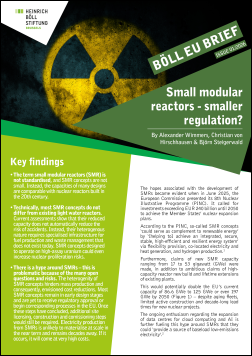
I invite you also to check out our recent Böll EU Brief on the false hype surrounding small modular reactors, published as we mark 15 years since Fukushima and 40 years since Chernobyl.

Wishing you a peaceful Easter,

Roderick Kefferpütz
Director
Heinrich-Böll-Stiftung
European Union | Global Dialogue

Highlights

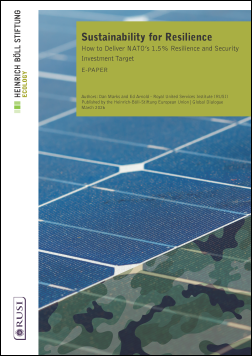
E-paper | Sustainability for Resilience: How to Deliver NATO’s 1.5% Resilience and Security Investment Target

NATO allies have pledged 1.5% of GDP to resilience – but good intentions aren't enough. A new paper by Heinrich-Böll-Stiftung EU | Global Dialogue and the Royal United Services Institute (RUSI) warns that without clear rules, the money risks disappearing into bureaucracy. The authors, Dan Marks and Ed Arnold from the Royal United Services Institute (RUSI), show how smart investments in energy, mobility, and supply chains can serve security and climate goals at once – and why getting this right is essential for credible European defence.


Presidents' column | European security also means renewables, power grids, and wetlands 

At February’s Munich Security Conference, Merz, Macron, von der Leyen and Co. testified to Europe's strength and independence. But concrete, independent strategies are often lacking. Europe now has the opportunity to play to its own strengths, including in the area of energy independence and sustainability, writes our President Jan Philipp Albrecht.


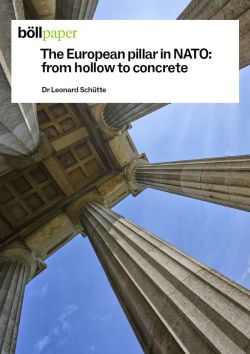
Policy Paper | The European Pillar in NATO: From Hollow to Concrete

Russia’s war of aggression against Ukraine and President Trump’s revision of 80 years of US Europe policy have shaken the foundations of the European security order. As a result, the debate about the future of NATO has returned with a vengeance. It is near consensual among Europeans that they need to strengthen the ‘European pillar in NATO’. However, the concept of the European pillar remains vague and details scarce, thus risking that the concept remains a hollow soundbite. This study by Dr. Leonard Schütte both looks back to unpack the rhetorical baggage of the European pillar of NATO and ahead to discuss what it would take to strengthen the pillar.


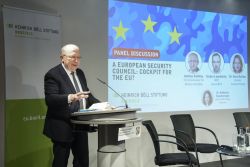
Event recording | A European Security Council: Cockpit for the EU? Debating proposals for a new decision-making body

The world around Europe is changing fast. Geopolitical shifts are challenging the international order, Russia’s war in Ukraine has upset the European security architecture. And old alliances are no longer as reliable. Faced with these challenges Europe needs to step up. But are EU decision-making mechanisms fit for purpose? The current modus operandi mostly requires consensus among the 27 Member States resulting in a slow response rate. Recent crises have thus revived calls for a “European Security Council”, an idea that has been prominently advanced by European Commissioner Kubilius. At the same time, MEP Sergey Lagodinsky has put forward a detailed institutional proposal outlining legal pathways, governance models, and safeguards for democratic legitimacy. Watch the recording of our panel discussion with EU Commissioner Andrius Kubilius, MEP Sergey Lagodinsky, Dr. Rosa Balfour (Carnegie Europe) and Dr. Katharina Emschermann (Heinrich-Böll-Stiftung EU | Global Dialogue).


Böll EU Brief | Small modular reactors – smaller regulation?

This Böll EU Brief by Alexander Wimmers, Christian von Hirschhausen and Björn Steigerwald critically assesses the prospects of small modular reactors (SMRs) in Europe. It finds that most SMR designs remain in early development, lack regulatory approval in the EU, and are unlikely to deliver electricity at scale before 2050. Technical, economic and political challenges – including high costs, unresolved waste management, proliferation risks and heterogeneous designs – undermine claims of rapid deployment and cost reductions. The authors conclude that prioritising renewables, storage and electrification is a more credible pathway for timely decarbonisation.

Read more
 

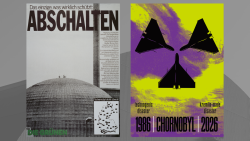
Web dossier | Chernobyl: 40 Years After the Disaster 

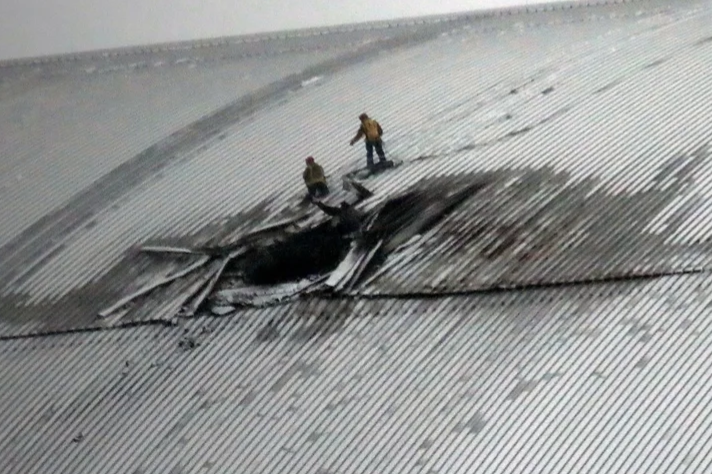
Forty years after the Chernobyl/Chornobyl reactor disaster, Russia is once again jeopardizing nuclear safety in Eastern Europe through direct attacks on nuclear power plants in Ukraine. Other countries seem largely unfazed, clinging to nuclear power and planning new reactors. Our dossier highlights how selected countries look back to this historical turning point and deal with nuclear energy today.


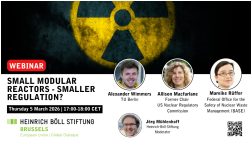
Webinar recording | Small modular reactors – smaller regulation?

At the occasion of the 15th anniversary of the Fukushima catastrophe, we presented a new analysis by researchers from the Technical University of Berlin discussing open questions in view of the development of small modular reactors (SMRs) in the EU. The European Commission has given SMRs a prominent place in its 2025 Affordable Energy Action Plan. However, given the long road of SMRs towards potential technology readiness and the assumed high costs of electricity generation, experts question if these projects would ever supply any meaningful quantity of electricity to businesses and consumers. Speakers: Alexander James Wimmers (TU Berlin, co-author of the new Böll EU Brief on SMRs in the EU), Allison Macfarlane (Former Chair, US Nuclear Regulatory Commission) and Mareike Rüffer (Head of Department Nuclear Safety, Federal Office for the Safety of Nuclear Waste Management (BASE), Berlin). Moderated by Jörg Mühlehnoff.

Rewatch the webinar
 

Online discussion | Navigating Sustainable Hydrogen in Times of Uncertainty: Entry Points for More Effective Governance
15.04.2026, 10:00-11:00 CEST

In this webinar, the Research Institute for Sustainability (RIFS) will present tangible options for strengthening governance to ensure sustainability along the hydrogen value chain, while simultaneously contributing to the acceleration of the hydrogen ramp-up. The recommendations build on a comprehensive review of existing sustainability requirements in the hydrogen sector. They highlight opportunities for promoting a more coherent and effective governance framework to support a sustainable ramp-up of hydrogen to meet climate and resilience objectives. 


Report debate lunch | Building Security Through Values
23.04.2026, 11:30-14:00 CEST

The event is dedicated to the launch of GEF’s new report New Idealism for a Disrupted Europe: Building Security Through Values, and will bring together policymakers, researchers, and practitioners to discuss how values-based politics can contribute to strengthening European resilience in a rapidly shifting geopolitical landscape. Drawing lessons from Central and Eastern Europe, including Ukraine, the report invites Europeans, but also Greens and progressives to rethink security, with few taboos. The new idealism it advocates aims to harness the power of values across a wide range of areas, from military and social resilience to diplomacy and democracy promotion. Moderated by Roderick Kefferpütz.


Event | 40 Years After Chernobyl: History and its new reality
23.04.2026, 17:30-21:00 CEST

Four decades on, the Chernobyl/Chornobyl disaster remains a defining moment: the collapse of Soviet credibility, the birth of Europe's nuclear debate, and a catalyst for Green politics. Today, the stakes are back. Russian forces have targeted nuclear sites in Ukraine, turning reactor safety into a weapon of war. What does Chornobyl mean in 2026? Join us for a discussion on green history and security in Europe.

 
Photo credits:
KhanunHaHa | Shutterstock & Joan Lanfranco, All Rights Reserved
 Sibylle Fendt / Collage: Heinrich-Böll-Stiftung licence, All rights reserved
IMAGO/imagebroker, All rights reserved
Zacarías García/ BR&U, All rights reserved
Roman | Pixabay, CC BY 2.0
Green European Foundation, All rights reserved
Archiv Grünes Gedächtnis, Initiative 4th Block/Alex Blyakher & Imago/Ukrinform, CC BY-NC 2.0

The Heinrich-Böll-Stiftung is a German political foundation affiliated with the German Green Party (Alliance 90/The Greens). Its primary task is political education and advocacy in Germany and abroad. Our main tenets are ecology and sustainability, democracy and human rights, non-violence and justice. In our work, we place particular emphasis on gender democracy, equal rights for minorities and the political and social participation of migrants.

Our namesake, the writer and Nobel Prize laureate Heinrich Böll, personifies the fundamental principles we stand for: defence of freedom and human dignity, civic courage, open debate and the acknowledgement of art and culture as independent spheres of thought and action. As a think tank for green visions and ideas, we are part of an international network with 34 offices worldwide and with partner projects in more than 60 countries.

The Heinrich-Böll-Stiftung European Union represents the foundation vis-à-vis European and international institutions, associations, non-governmental organisations and media based in Brussels. The office is a main point of contact for individuals, groups and organisations from around the world interested in EU politics and policies. The future of the European project and the role of the European Union in the world are at the centre of our activities and efforts.

If you don't want to receive any more messages (to: unknown@noemail.com), you can unsubscribe here at any time.
Heinrich-Böll-Stiftung European Union | Global Dialogue
Rue du Luxembourg, 47-51
B-1050 Brussels
Belgium

Joan.Lanfranco@eu.boell.org
Website

Your personal data is confidential and will not be forwarded to Third parties according to our Privacy Policy.